Showing posts with label Chantilly. Show all posts

Monday, September 5, 2016

3 Sites to see in #Paris if you love #Georgian and #Regency #romance!

We authors of historical romances love to do our research in those locations that bring the period and the people to life. Most often for Regency or Georgian Romance authors and readers, we travel around England, Scotland or Ireland.

But Paris has much to offer too for someone who wants to soak up the atmosphere of the period when Prince of Wales was Regent and Britain was at war with Napoleon. What could those places be?

Entrance to Malmaison
Part of Josephine's toilette.
First, I offer up the delights of Josephine's home south of Paris in the current suburbs. Malmaison (available by the Metro) is a term that really derives from the terms meaning "bad house' from the period when the Vikings raided through here and destroyed all in their path. The house, built a few decades before the Bonapartes purchased it, is a jewel of perfection of this period. Surrounded by
The back of Josephine's salon.
Josephine's rose gardens and the rest of her beautifully landscaped lawns, the house is lovingingly maintained today by the State. Most of the decor and the furnishings are original to the period if not the house per se and the audio tour (which you must take!) describes the uses Josephine put to the house. The card room, for example, is a small—very small—room, almost a closet. But the empress loved it for its intimacy and warmth. The salon which still holds her harp and her pianoforte contains much of her private art collection as well as furniture. You can almost see the dignitaries conversing, drinking tea or wine, remarking on the politics of the day. Her bedroom where she died is quite stunning in its rich canopy. Most alluring is her toilette, small, the walls swathed in cotton and linens to increase the warmth. Often when she bathed and dressed, Josephine took three hours!
Napoleon's private bedchamber.

A visit to the Cathedral of Saint Denis on the northern tip of Paris (and available by the Metro) is a trip to acquaint you with the horrors of the French Revolution and the Terror, the counter influence on the British mindset during the wars of that period.  Saint Denis is the church in which most of the kings and queens of France and their children are buried.  I say most of them because many are indeed buried elsewhere. However, once you've entered and admired this church, the first gothic cathedral in France and its architecture, and once you've admired the enormous number of sarcophagi of various French monarchs and their families, a visit to the crypt is what you're really after. Here you will find the plaque on the wall which is all that remains of that noted monarch, Louis XIV. It is ironic to find his burial place in such a barren place. But walk further into the center of the crypt and here you see only a huge flat black granite stone covering a very deep pit. This is the marker for the burial plot of those aristocrats of the ancien regime who died by the guillotine during the Revolution and most numerously the Terror. Their bones were collected from various churchyards and from the Conciergerie (on the Isle de France) where they were interred after execution. This tragedy of their deaths by violent means is the very horror that outraged the British, many of whom were their relatives. This slaughter of the nobility is what the British sought to avoid for themselves. While they spent significant national treasure attempting to defeat the various regimes that succeeded the Bourbons, including the emperor Napoleon, they were attempting to ensure not only their own survival, the continuance of their economic system, but also their naval power around the world.
The dining room in Malmaison

Chantilly lies north of Compiegne, and to get here you must buy a train ticket for roughly $11.00 at Gare du Nord to travel beyond the Metro line. But you will adore the easy walk from the train station (1.5 miles) and the ambiance of the forest and the town. The first owners of the chateau were the Montmorency family of soldiers and diplomats. Rising to prominence during the reign of Francis I, Anne du Montmorency ( a man) made his name serving the king. Later, cousins to the Bourbon monarchs, the Princes Conde became owners of the chateau. With landscape designed by the famous gardener Andre Le Notre, the grounds are sumptuous in the Baroque manner. Even the stables are lavish in their appointments. What is notable here are the decor and furnishings much of which dates from the Bourbon Restoration of 1815 when the nephew of the newly restored Louis XVIII and his brother Charles X was granted the property. There his descendants remained until the 1880s when they could not longer pay the taxes and turned the building over to the government.
Louis XIV plaque in crypt of Saint Denis
Life size gisants of praying Louis XVI and his wife, Queen Marie Antoinette in chapel of Saint Denis


Chateau Chantilly: View of the stable block and riding academy.

Walter view of Chantilly


Salon with murals commemorating the Fronde led by the Grand Conde.

A portion of the music room with harp.
+N.B. All the photographs are mine.


Monday, July 25, 2016

A gorgeous palace, chateau set on water, #Chantilly and its glories! #France

   
The entrance to the chateau
Watching the Tour de France with my husband, I yearn for more pictures from that helicopter!
     Did you?
     If so, I aim to provide!
     Here are mine of that fabulous palace owned by lesser Bourbons (and before that the Duc de Montmorency). This palace approximately 50 miles north of Paris is easily accessible by SNIF, the regular local commuter train.
    Do go!
    The walk from the train station is a bit of a hike so you may raise your hand and try a taxi. But however you go, do take your camera and save your appetite for gorgeous Rococo architecture, furnishings, the riding stable, art and fabulous lunch from the on site restaurant. Yes, they serve. And they serve a lovely array of dishes, including original Chantilly cream. Order it and do so quickly when you sit down because they tend to run out! Visit the website for more info:  Chateau Chantilly
   
      In fact, the kitchen was the site of the Gerard Depardieu film Vatel to create the kitchen of that other fabulous chateau, Vaux le Vicomte http://www.vaux-le-vicomte.com/en/.

   
     The main house tour centers on the ground floor. The beauties here include a map of the main battle of The Fronde which was an uprising fomented against the child Louis XIV. Given to the French Republic by the last nobleman to own the house, the chateau is maintained by the French and beautifully so.
   
     The major attraction for many visitors is the library, renowned for its vast collection (under glass protection) of first editions of centuries' old volumes. The other rooms include the duke's offices, a ballroom, a music room and various reception rooms. The power and majesty of the chateau, for me, was in the alabaster white of the walls with gold leaf filigree everywhere.

The private chapel holds at ihefront altar a crypt wherein all hearts of the dukes are buried.
Hidden during the Revolution, this crypt was returned after the Republics of France assumed power over governing.


Thursday, January 1, 2015

Cerise went to #Paris, stayed in #Montmarte, went to #chateau of #Chantilly and ate in famous #kitchen!

View from our 6th floor Paris apartment in Montmarte!
A sunny day in October!
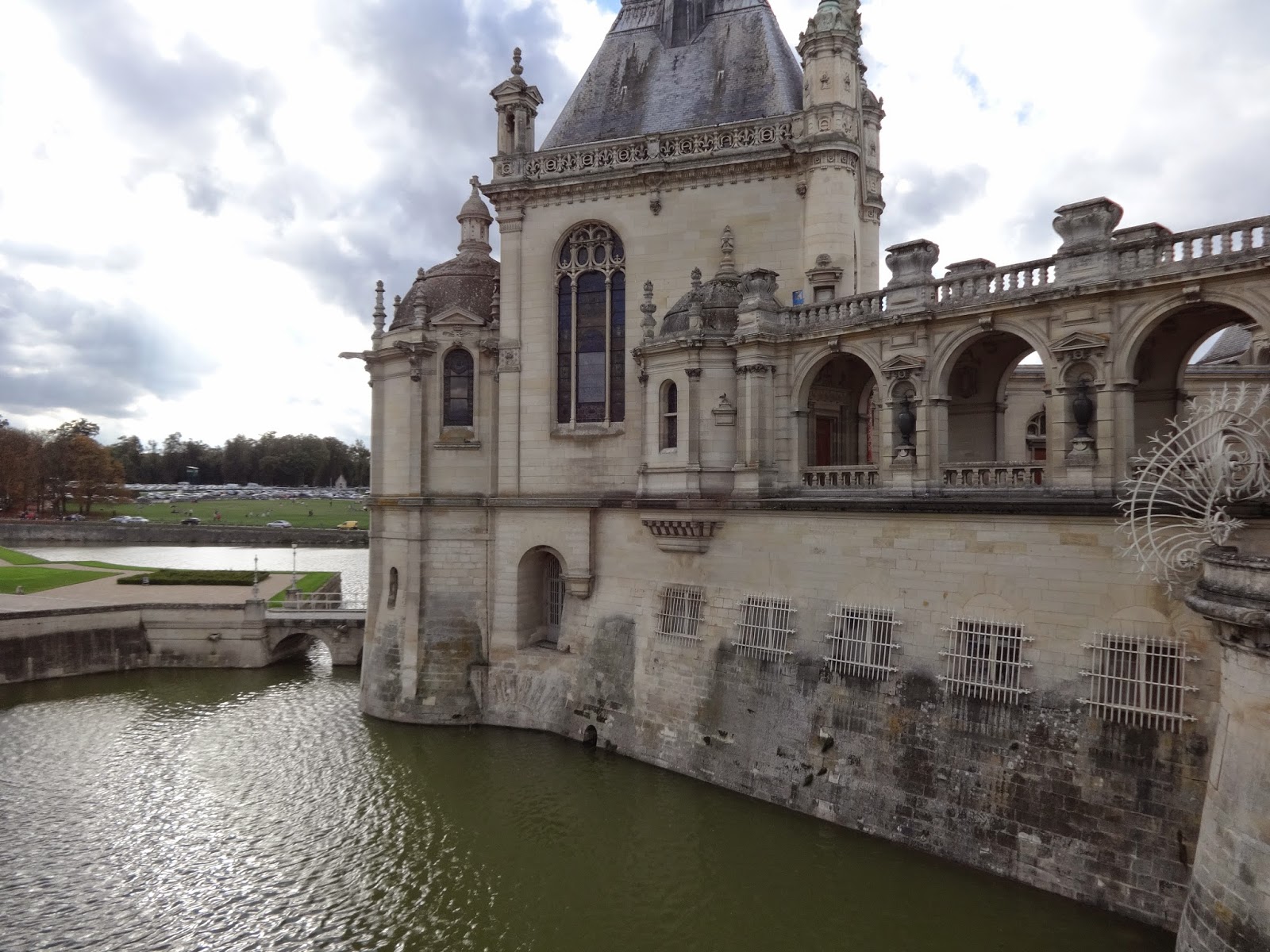
Known as the largest, best preserved of the grand chateaux in France, Chantilly is a gorgeous edifice in the Paris suburbs. To get there, as we did, by RER train, is quick and easy. We had a NAVIGO card, which I recommend you buy and so our trip was quick and affordable. It was especially so because we stayed in Montmarte, and here is our view from our apartment.

Chantilly, originally built by the Montmorency family, was owned by the great rival of Louis XIV, the Grande Conde. This nobleman led a famous battle which he won resoundingly, and thus became a powerful man in his own right. He rebelled against the famed Louis, but lost his hegemony. I leave it to you to investigate further, should you desire. My attempt here is to give you highlights, not necessarily the in depth history of the chateau.
One entrance through which you access the
kitchen, now a restaurant that serves marvelous food!

Devolving from the Montmorency family, Chantilly went to the Grande Conde and then after the French Revolution and Napoleon, on to the Bourbons once again. The last owner was the nephew of the last Bourbon king to rule France, known as the Duke D'Aumale. It is his house and furnishings which are largely on display at this marvelous estate.

Known for the stables and horse breeding, the stud is a well known one in France and today it is still used for races and such. The arena is huge and on the Sunday we visited, they were hosting a competition there beyond the elaborate gates.

Along the moat, the house seems to float.
Inside the main house, the grandeur tends to overwhelm with huge circular marble staircases, a superlative art collection including portraits of each of the Bourbon kings and the original of the 3 Graces.

If you go, do plan enough time to dine in the kitchen which is now a fabulous restaurant. Yes, they serve Chantilly cream on their puffs for dessert. But the rest of the menu is scrumptious, too. If you have seen the movie VALMONT about the famous French chef who served a famous house party where Louis XIV was guest, you will sit in the same room as he...and dine well!
The main entrance to the chateau. 
Entrance to the stables. Inside is a show arena.
Rococco decor on the front gates of the stables.
Chairs in the Duke's office, not exactly conducive to conversation!

The music room with the duchess's harp.

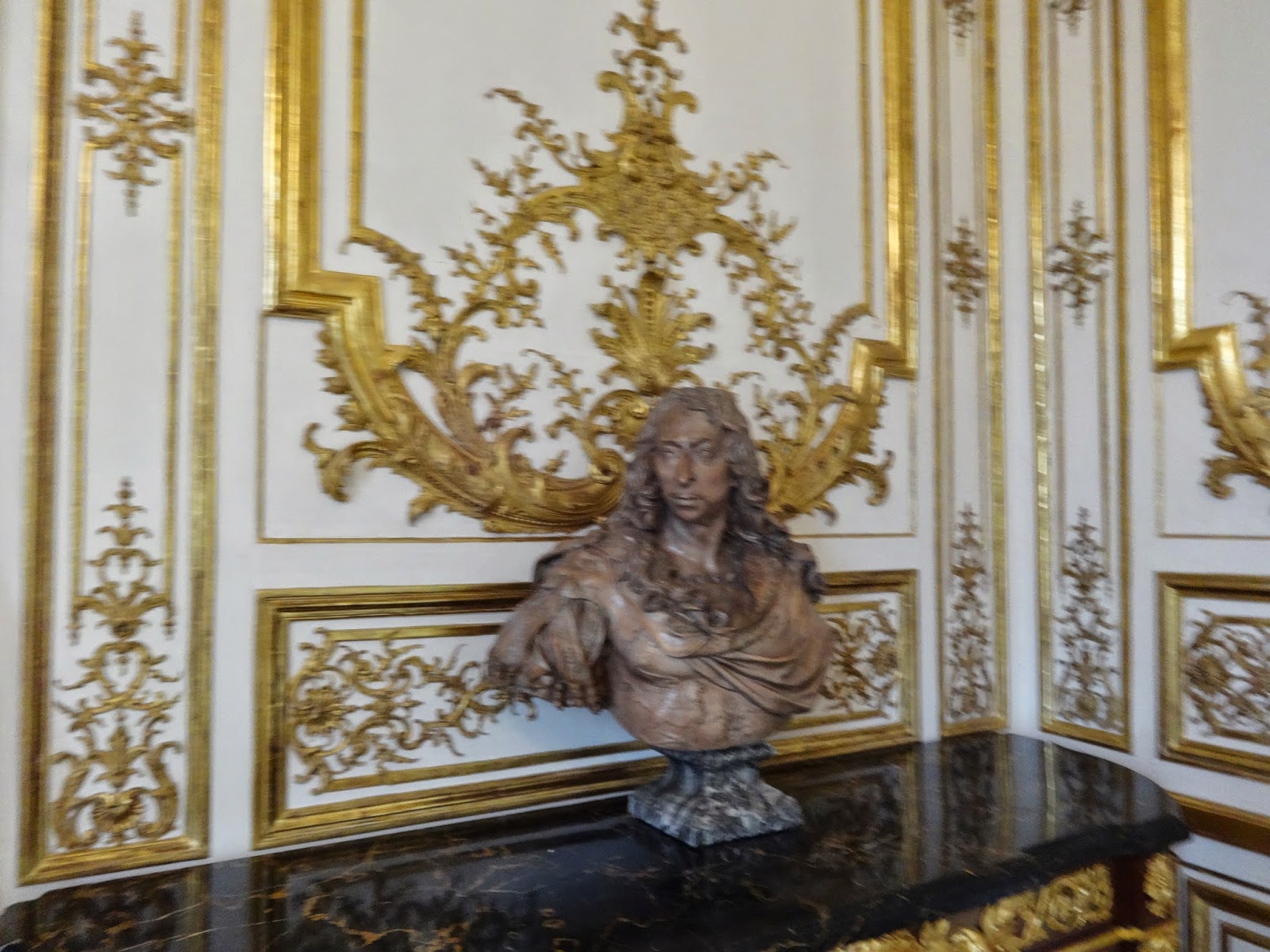
A bust of the Grande Conde.

The family chapel in the chateau. Note the French canopy of blue and gold as well as
the black marble altar pieces. Inside these are buried the hearts of the dukes who lived here.
Yes, this was a tradition until the last duke to give his heart after death in the 1860s.

I leave you with a picture that was the very devil to take!
The ornate ceiling of the family chapel with its shields, carvings of gold and blue amid the light
from fabulous stained glass windows.