FOLLOW ME! BOOKMARK ME!
Amazon - https://www.amazon.com/-/e/B0089DS2N2
Bon Bons Blog - https://cerisedeland.blogspot.com/
BookBub - https://www.bookbub.com/authors/cerise-deland
Facebook - https://www.facebook.com/CeriseDeLandAuthor/
Goodreads - https://www.goodreads.com/author/show/2940404.Cerise_DeLand
Instagram - https://www.instagram.com/cerisedeland/
Travels with Cerise YouTube - https://www.youtube.com/channel/UCba82P_Q1kUrJUVVW0CwJmw/
Website - http://cerisedeland.com
Showing posts with label Paris travel series. Show all posts
Showing posts with label Paris travel series. Show all posts
Saturday, July 25, 2026
Tease me! Kiss me! Thrill me! All the places, posts, pix, videos and confessions I have made! Go everywhere! LOL!

Wednesday, November 15, 2017
DARING WIDOW enchants a prince in DeLand's blissful Victorian romance! Pre-order for half today!
 |
| Pre-order on AMAZON now! |
Andre Claude
Marceau, Duc de Remy and Prince d’Aumale, finds Marianne’s joie de vivre enchanting—and her plan for a temporary affair with
him impossible.
He offers her one
night in his arms, and to his delight, she craves another. But he needs more
from her than a few hours of bliss. So when he shows her how to fill her days
with passions that complement those they enjoy together at night, Marianne must
choose.

Thursday, June 1, 2017
Cerise went to #Paris! It's #research #champagne #chocolate #France #romance and my Pictures!
Yes, dahlinks, I went off to Paris!
Drop me a comment here about what you'd bring back!
Champagne?
Chocolate?
A French comte or marquis?
All of the above???
Sigh.
Me, too.
Here are a few of my pictures from trips past!
And here's a hint: Sign up for my newsletter for more info here: http://eepurl.com/bZ6xkj
 |
| USA's 100th Anniversary of WWI http://www.worldwar1centennial.org |
Champagne?
Chocolate?
A French comte or marquis?
All of the above???
Sigh.
Me, too.
Here are a few of my pictures from trips past!
And here's a hint: Sign up for my newsletter for more info here: http://eepurl.com/bZ6xkj
 |
| Mr. DeLand and I at a chateau along the River Marne when we spent two and a half weeks trailing the American Expeditionary Forces battle lines of 1917-1918. Did you realize that the 100th anniversary of American involvement in WWI occurs now? |
 |
| Center Hall in Opera Garnier, Paris! |
 |
| Josephine's Malmaison in Parisian countryside, her dining room! |
 |
| This charming church is in Varennes, France (near Verdun) where the French king, Louis XVI and his wife Marie Antoinette and their two children took refuge in 1791. Sadly, they were caught by the villagers and returned to Paris where they died at the guillotine. |
 |
| Once the House of Worth stood in this #7 Rue de la Paix near the Opera Garner in Paris! |
 |
| Cathedral of St. Peter on fashionable Rue di Rivoli in Paris |
Monday, September 5, 2016
3 Sites to see in #Paris if you love #Georgian and #Regency #romance!
We authors of historical romances love to do our research in those locations that bring the period and the people to life. Most often for Regency or Georgian Romance authors and readers, we travel around England, Scotland or Ireland.
But Paris has much to offer too for someone who wants to soak up the atmosphere of the period when Prince of Wales was Regent and Britain was at war with Napoleon. What could those places be?
First, I offer up the delights of Josephine's home south of Paris in the current suburbs. Malmaison (available by the Metro) is a term that really derives from the terms meaning "bad house' from the period when the Vikings raided through here and destroyed all in their path. The house, built a few decades before the Bonapartes purchased it, is a jewel of perfection of this period. Surrounded by
Josephine's rose gardens and the rest of her beautifully landscaped lawns, the house is lovingingly maintained today by the State. Most of the decor and the furnishings are original to the period if not the house per se and the audio tour (which you must take!) describes the uses Josephine put to the house. The card room, for example, is a small—very small—room, almost a closet. But the empress loved it for its intimacy and warmth. The salon which still holds her harp and her pianoforte contains much of her private art collection as well as furniture. You can almost see the dignitaries conversing, drinking tea or wine, remarking on the politics of the day. Her bedroom where she died is quite stunning in its rich canopy. Most alluring is her toilette, small, the walls swathed in cotton and linens to increase the warmth. Often when she bathed and dressed, Josephine took three hours!
A visit to the Cathedral of Saint Denis on the northern tip of Paris (and available by the Metro) is a trip to acquaint you with the horrors of the French Revolution and the Terror, the counter influence on the British mindset during the wars of that period. Saint Denis is the church in which most of the kings and queens of France and their children are buried. I say most of them because many are indeed buried elsewhere. However, once you've entered and admired this church, the first gothic cathedral in France and its architecture, and once you've admired the enormous number of sarcophagi of various French monarchs and their families, a visit to the crypt is what you're really after. Here you will find the plaque on the wall which is all that remains of that noted monarch, Louis XIV. It is ironic to find his burial place in such a barren place. But walk further into the center of the crypt and here you see only a huge flat black granite stone covering a very deep pit. This is the marker for the burial plot of those aristocrats of the ancien regime who died by the guillotine during the Revolution and most numerously the Terror. Their bones were collected from various churchyards and from the Conciergerie (on the Isle de France) where they were interred after execution. This tragedy of their deaths by violent means is the very horror that outraged the British, many of whom were their relatives. This slaughter of the nobility is what the British sought to avoid for themselves. While they spent significant national treasure attempting to defeat the various regimes that succeeded the Bourbons, including the emperor Napoleon, they were attempting to ensure not only their own survival, the continuance of their economic system, but also their naval power around the world.
Chantilly lies north of Compiegne, and to get here you must buy a train ticket for roughly $11.00 at Gare du Nord to travel beyond the Metro line. But you will adore the easy walk from the train station (1.5 miles) and the ambiance of the forest and the town. The first owners of the chateau were the Montmorency family of soldiers and diplomats. Rising to prominence during the reign of Francis I, Anne du Montmorency ( a man) made his name serving the king. Later, cousins to the Bourbon monarchs, the Princes Conde became owners of the chateau. With landscape designed by the famous gardener Andre Le Notre, the grounds are sumptuous in the Baroque manner. Even the stables are lavish in their appointments. What is notable here are the decor and furnishings much of which dates from the Bourbon Restoration of 1815 when the nephew of the newly restored Louis XVIII and his brother Charles X was granted the property. There his descendants remained until the 1880s when they could not longer pay the taxes and turned the building over to the government.
+N.B. All the photographs are mine.
But Paris has much to offer too for someone who wants to soak up the atmosphere of the period when Prince of Wales was Regent and Britain was at war with Napoleon. What could those places be?
 |
| Entrance to Malmaison |
 |
| Part of Josephine's toilette. |

 |
| The back of Josephine's salon. |
 |
| Napoleon's private bedchamber. |
A visit to the Cathedral of Saint Denis on the northern tip of Paris (and available by the Metro) is a trip to acquaint you with the horrors of the French Revolution and the Terror, the counter influence on the British mindset during the wars of that period. Saint Denis is the church in which most of the kings and queens of France and their children are buried. I say most of them because many are indeed buried elsewhere. However, once you've entered and admired this church, the first gothic cathedral in France and its architecture, and once you've admired the enormous number of sarcophagi of various French monarchs and their families, a visit to the crypt is what you're really after. Here you will find the plaque on the wall which is all that remains of that noted monarch, Louis XIV. It is ironic to find his burial place in such a barren place. But walk further into the center of the crypt and here you see only a huge flat black granite stone covering a very deep pit. This is the marker for the burial plot of those aristocrats of the ancien regime who died by the guillotine during the Revolution and most numerously the Terror. Their bones were collected from various churchyards and from the Conciergerie (on the Isle de France) where they were interred after execution. This tragedy of their deaths by violent means is the very horror that outraged the British, many of whom were their relatives. This slaughter of the nobility is what the British sought to avoid for themselves. While they spent significant national treasure attempting to defeat the various regimes that succeeded the Bourbons, including the emperor Napoleon, they were attempting to ensure not only their own survival, the continuance of their economic system, but also their naval power around the world.
 |
| The dining room in Malmaison |
 |
| Louis XIV plaque in crypt of Saint Denis |
 |
| Life size gisants of praying Louis XVI and his wife, Queen Marie Antoinette in chapel of Saint Denis |
 |
| Chateau Chantilly: View of the stable block and riding academy. |
 |
| Walter view of Chantilly |
 |
| Salon with murals commemorating the Fronde led by the Grand Conde. |
 |
| A portion of the music room with harp. |
Wednesday, April 6, 2016
Cerise went to #Hampton Court near #London, brought home #wine and a gentleman!
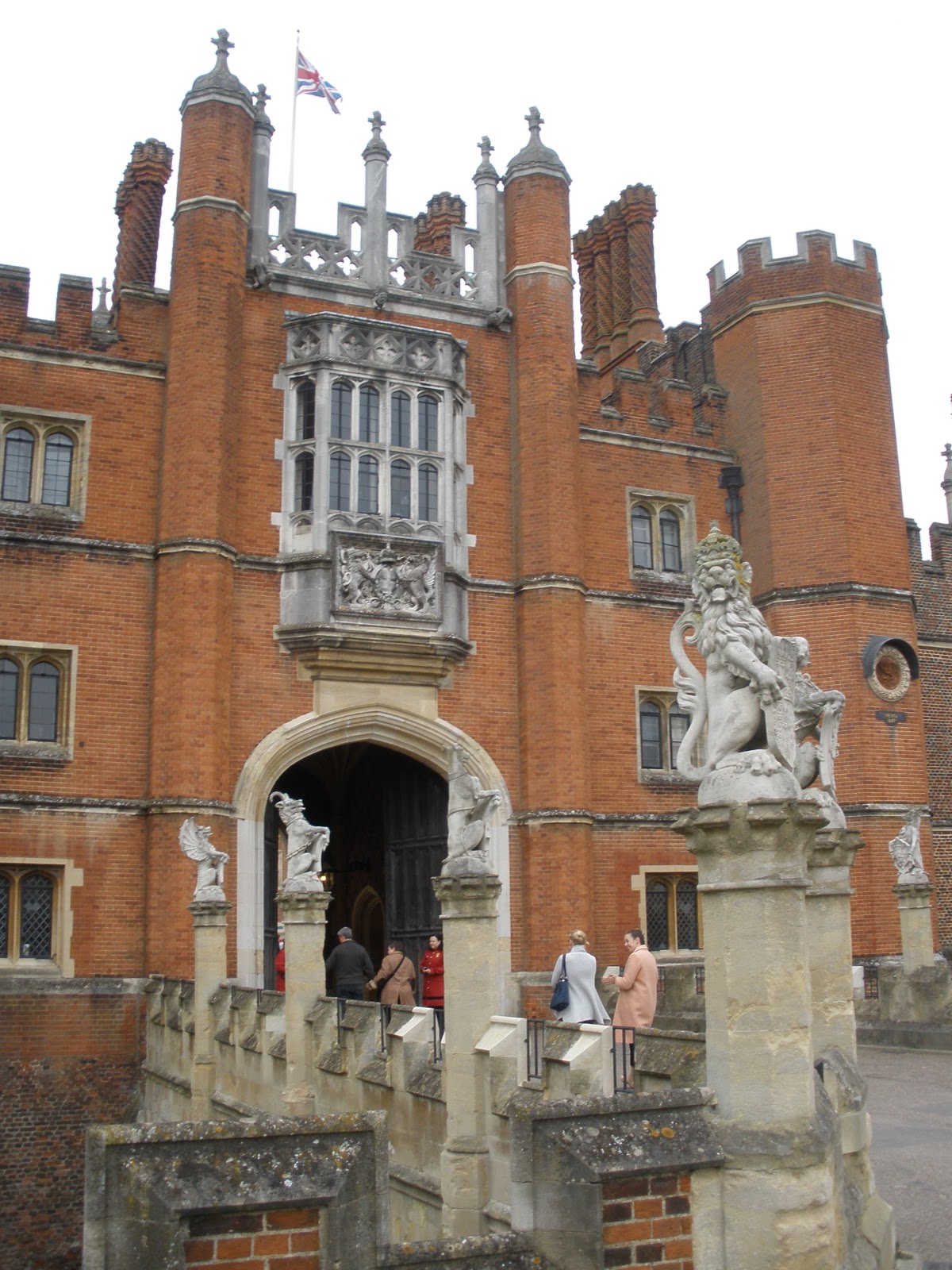 |
| Front entrance. My picture. You will note the different griffins or lions. All below are my pix! |
My trip with Mr. DeLand from inner London to Hampton Court was just such a train journey.
The Tudor period is fascinating but not my Fave. It's filled with characters like Henry VIII whose actions and hubris boggle the imagination. Some places I visit show me the character of the person who lived there.
Hampton Court Palace certainly did that for me and I want to tell you and how and why in words and pictures!
Did you think that King Henry VIII had gout because he ate only meat? Drank too much wine? Ate too few vegetables?
You would be so right. Visiting Hampton Court on my last trip to England and listening to the audio tour proved the rumor of Henry's gourmand sensibilities. True, he had at his court hundreds of courtiers who needed to be fed. True, he was zealous when it came to watching them to see they remained loyal. (All those tiny eaves' droppers in the rafters are rather frightening...and made me wonder if someone had installed inside them small CCTV cameras.) True, the number of servants required to feed such an entourage was daunting.
 |
| More griffins! |
Why pies?
Pie with crusts serves as a convenient means of serving hundreds of people quickly and efficiently. They can be composed of all vital ingredients, packed together into a savory self-contained meal, baked easily together, cooled easily and dispensed just as easily. Servants could quickly grab a pie, eat it and get on with their duties. And unlike the way we eat pie today, they would discard the crusts, lick their fingers (note necessarily wash them!) and march onward!
 |
| The huge roasting spit at work today! The pokers sticking out at an angle show the different positions of the racks. Men turned the spits and many weretrained for years at the art of roasting a side of meat. |
 |
| Queen Caroline by Joseph Highmore |
She was well loved, initially by her cantankerous husband, and later by her people.
I was intrigued to learn that Hampton Court is run by a private foundation, not the Crown. A marvelous short excursion for you from London, this 30 minute trip to Hampton Court offers you a wonderful tour of the house and grounds, a glimpse of two periods in which the house was occupied by royalty—and a scrumptious tea shop with gloriously steaming, creamy hot potato soup and home made bread! (Other items, too. But on the cold day we were there, this fare hit the spot.) And as for that gentleman I brought home with me to consult on future novels?
He's having a wonderful time listening to Rhianna and watching all the James Bond flicks. I cannot get him away from the political coverage. His advice is simply to have our prime minister dismiss all those running as nincompoops. I keep telling him we have no p.m., but he thinks I'm mad when I speak of a president and congressmen elected by the people. "There's your problem," he tells me. "Clean house. Put in a parliament. Then they all have to find a way to get along."
I'm sticking to writing romances, I have oft told him. I need info on that. But he's insistent that he knows nothing of love. The man needs a wife. I can see it in his blue, blue eyes.
 |
| Henry's kitchens: Oh, the pies! A lot of them, too! |
 |
| Pots for making soups and stews, cooked over grills! |
 |
| The storage room for the plate. Each piece was counted after every meal. No theft here! |
 |
| Henry's wine cellar. Dark, cool and full. |
 |
| The second addition to the Palace is this Georgian period wing, all lovely symmetry outside. Inside, the walls are dark walnut, the appointments dazzling silver and the atmosphere, secretive and murky. |
 |
| The emblem of the castle and Tudors outside the entrance to the Chapel Royal. |
Sunday, January 24, 2016
Cerise went to #London, #Bath, #Osterley, #Hampton; shows pix, tidbits!
 Launching the newest in my travel series to hopefully inform, entertain and delight you, I am tickled to begin with a selection of pictures. This past October, my husband and I went to England for a much-overdue trip. Yes, it was research. Yes, it included marvelous food and great restaurants and B and Bs. Yes, it included lots of walking. We took good shoes, wore layers for the chill...and had in hand our umbrellas.
Where did we go?
Hampton Court, Osterley Park, the Tower (for the empty-umpth time), St. Paul's (again!) and all the delights of Bath and riding the efficient Great Western Railway. In between, we dined. Hubbie is a restaurant reviewer and so we "feed" his passion. I'll share the best of the best with you!
First stop was Apsley House that gorgeous home of the Duke of Wellington. With more details to come, I will tell you one fact struck my husband, who is not a history nut as are others in this family. He commented that Wellington seemed to respect Napoleon. Why else would he have a marble statue of the man in his foyer? It is true that the Duke did think the Frenchman's skills were to be respected, honored and feared. Here's the statue. We had no other pictures of the house as it is not possible to take them because flash deteriorates fabrics, art, decor, etc.
After leaving Apsley, we walked along Piccadilly and stopped into a French patisserie
for French afternoon tea and divine pastries. One must keep up one's energy...and calorie count.
We did the Royal Cavalry Museum and smiled at the officers. Patted the horses. Went on to the Royal Mews which we highly recommend for those of you who always get a charge out of watching Britain's royal family take a little jaunt down the Mall in fabulous carriages. One carriage that knocked my socks off was the 22 carat golden leaf carriage made for George III in 1762. Here it is in all its fabulously gaudy glory!
 |
| George III's Gold State Coach, 1762. Interior art by Italian artist Cipriani. |
 |
| Front Portico, Osterley Park |
We also toured that famous house Osterley Park in suburban London. This house, redecorated into a Palladian beauty by Robert Adam. Here the joys of the house included the Long Hall, meant for exercise when the weather prohibited one from walking outside.
We strolled through London to find South Moulton Street, where once modistes had shops, and now many fabulous shops still cater to avid shoppers. Past Hanover Square, we went to that famous church St. George's.
 |
| Fashionable South Moulton Street now and during the Regency! |
Monday, July 20, 2015
Going to #London, #Paris? Go the old fashioned, fun ways!
 |
| Gare de L'est Main Concourse |
Need a vacay? Hey, me too! If only to please my
significant other who says I spend too much time tapping the keys and talking
to "others" on TW and FB! (Really??? I do that? Time flies
when you are having fun!)
This fall, he and I are going to...drum roll
here...England. And our current argument...um, discussion...is about
length of stay. Eight days? Ten? Fifteen?
I often vote for as long as I can get him to
agree to the budget (a term I use too loosely which is why we have our
discussions). Our longest vacay recently was a glorious 18 days in eastern
France covering the American battlefields of WORLD WAR ONE. But I can get him
to agree to 14 days and 10 often!
What do we do? And why do we stay so
long?
First, very important here, we skip
all hotels. Why? Too expensive AND they never let you in until 3 in the
afternoon and by that time, you are ready to skin the receptionist because you
are so jet lagged.
 |
| http://amzn.to/1dWojVz |
We rent an apartment. With washer and
dryer so you can take a smaller suitcase. And a dishwasher. No, not hubby. A
mechanical dishwasher. BUT we have also found that in Europe, people tend
to sleep very close together. Single beds or double are the norm. You wince? We
do, too. Ergo, hunt for that rental that sports a queen or, if you really need
it (and we do), a king. Tough to find but they are there, trust me.
I
s an apartment really that much more
affordable? It is. Just think. You have your coffee and breakfast in house. You
have a refrigerator so you can, if you wish, pack a lunch. We don't but it is
an option, especially if you have food sensitivities or allergies and must do
this for health.
How do we plan? We decide before we go
exactly what we plan to see. In order. Then we figure out if there is a Metro
card (Visite, in Paris, London GO in London) and the right
time period we need to purchase! We are also good to ourselves and KNOW that
the first day we're there, we are good for the move in, breakfast at a local
cafe, a nap and a glorious dinner. No touring. THEN, the next day we begin.
Our WORLD WAR ONE trip began in
Paris where we went to Les Invalides, where they have the most marvelous
collection of items for display for the world wars. We did the Musee
D"Orsay, walked along the Seine, and drank champagne till we couldn't any
longer...at least, not that day.
What did I get from this trip that took us to
Compiegne where the Armistice was signed in 1918 and to Verdun where the most
costly battles were fought and to a wonderful museum in Meaux devoted entirely
to the La Grande Guerre?
I got HEROIC MEASURES,
written under my other name. This novel is about thousands of American women
whom you've never heard of or eve thought about...I bet. American nurses
who volunteered to go to France to nurse Doughboys in 1917 were paid HALF
what an Army private was paid and had no rank. NONE. I could go on, but
hope instead you will read my novel about these truly heroic Americans.
********
BUY LINKS for HEROIC MEASURES:
Amazon:
http://amzn.to/1dWojVz digital
http://amzn.to/1f30XAx
print
Barnes and Noble: http://www.barnesandnoble.com/w/heroic-measures-jo-ann-power/1117014178?ean=2940148469186
Allromanceebooks.com : https://www.allromanceebooks.com/product-heroicmeasures-1310153-162.html
Wild Rose Press: http://www.wildrosepublishing.com/maincatalog_v151/index.php?main_page=product_info&cPath=209&products_id=5334

********
Last fall, we went to Paris again and this
time our agenda was to trace the history of France by visiting a few
significant places in and around Paris—and to do so by taking only the Metro or
the train! We stayed for 15 days and let me just say, that it was
marvelous. We walked at least 3-4 miles a day, because you leave the train
station, by golly, you are hoofing it to the site you wish to see. BUT armed
with good walking shoes and our umbrellas, we did it. And then—yes, you guessed
it—we dined. And I must confess, we drank well, too. Because well, it is France
you must taste the local produce, right???
What did I get out of that visit?
Well, I got marvelous backgrounds for my "Cerise went to Paris" Blogs
on my own blog here: http://cerisedeland.blogspot.com
And I have wonderful info for my next few Regencies as Cerise! Do read THE INCOMPARABLES, 6 HEROES OF WATERLOO AND THE 6 LADIES THEY ADORE
BY 6 INCOMPARABLE REGENCY AUTHORS for 99 cents out now! The 6 are:
Sabrina York, Dominique Eastwick, Suzi Love, Suzanna Medeiros, Lynne Connolly
and me!
And the material I researched appears
in my entry in that box set, INTERLUDE WITH A BARON, Regency Romp #4...and
in the soon to be released #3 in that series, MASQUERADE WITH A MARQUESS!
Keep traveling and keep reading!
Monday, July 6, 2015
Cerise went to #Paris and shares 5 FAB.U.LOUS FREE things to do there!
 You know I love to share my travels, especially to Paris and soon (be still my heart) to England and Bath!
But for Paris, ah, ma cherie, I have good news for you!
Aside from spending money, the best thing to do in Paris is spend time!

5. Walk along the Seine
Throw the guidebooks away for a day. Especially if that day is sunny. Take the Metro. Walk.
Go to Point Zero, which is a point in front of Notre Dame from which all points in France are measured!
Stroll along the river to admire the vendors with old postcards, prints, paintings, clothing and snacks!
Take pictures and breathe in the Paris air.
Buy an ice, if you must. But inhale the aromas of French roast coffee and baking croissants. Admire the flowers. I've never seen such blooms.
 Walk over to the Place des Vosges, ordered built by Henri IV and a favorite place for Parisians today to take a picnic!
 |
| Doors at entrance to Napoleon's Tomb |
Gives me chills every time I see it.
What a man he must have been.
Be sure to pay homage to General Foch who was the last of four French generals to lead the French military in La Grande Guerre, in the First World War.
Carried by a member of each of the branches of the French military, his coffin denotes the sorrow of the French who suffered enormous the destruction to home and civilians during that first global conflict.
 |
| General Foch carried by his French comrades in Les Invalides |
 3. Visit the train stations!
I know you think I'm nuts, but really, they are a slice of architectural beauty. My favorite is Gare (pronounced not Gar, as in garage, but Garrrrrrrr) de L'Est. This Station of the East is a beauty opened in 1849 and it retains all the glorious expansive beauty of the Belle Epoch. Look at the fan windows. Admire the wide concourse. Both were innovations in their day.
Now imagine through here traveled millions of French and American soldiers from 1914 to 1919. Why?
The fronts were to the north of Paris for all Entente forces. The American front for the American Expeditionary Forces was to the north and east and the best way to get to them, if not by truck convoy, was by train. Often these train tracks did not couple and forces had to wait for hours for the arrival of another train on an adjoining track. Needless to say, the journey was long and arduous.
 The cars, during wartime, were overcrowded, stinky, few seats available, without WCs (bathrooms, to Americans) and without any refreshment or dining cars.
People fled the fighting and the bombs and the invading armies on these trains. Carrying their chickens, their family photo albums, their clothes, millions boarded these trains and fled south. Many never returned. Villages were abandoned to the men fighting with sabers, rifles, flares, chemical gases and cannon.
2. Take the Metro to Montemarte and walk into the square where you will find dozens of artists selling their wares.
If walking distances is a challenge, get off the Metro at Lamark and walk up up up the stairs. Good for the gluts, you see. (Yes, then another set of steps to the square!)
Dart into the many galleries to admire works by contemporary artists.
Walk down the steps toward Rue de Caulingcourt (named after one of Napoleon I's closest friends, ambassador to Russia and famous general). Note The Agile Rabbit on your right where dozens of Impressionist painters and sculptors and writers went nightly to drink and inspire each other!
Stroll along the Rue and walk into a wine shop for your vin. Next door, buy a cheese (dozens to choose from) and a demi baguette. Further along is a fabulous shop whose owner rotisseries chickens and little potatoes in a little roaster right out there on the sidewalk!
Take them all home or to your hotel and feast!

Pack a lunch to sit in the gardens! Buy a sandwich of brie and ham, a chocolate croissant and coffee and admire what was saved for you by a Nazi general who refused Hitler's order to burn Paris in August 1944. Drop into Laduree and buy scrumptious macaroons.
Sit and imagine you are Marie Antoinette or Josephine or even Napoleon I or his nephew, Napoleon III admiring the view. Yes, on this site there once stood a Tuileries Palace where Marie Antoinette hid from the Revolutionaries and where Josephine bemoaned Napoleon's affairs. Admire what Napoleon saved and improved about Paris which include the bridges that bear his N emblem, river transportation, water availability and many roads into the capital.
Thursday, April 23, 2015
Cerise went to #Paris, then to #Reims where kings were crowned, #travel #WWI

Taking the rapid train to the north east from Gare de L'est, we walked through the gorgeous old city toward this beautiful cathedral. (Do note this walk is approximately 2-3 miles to the cathedral!)
Undergoing restoration (as so many French churches are these days), this church shows the contrast of light with dark. Reims Cathedral is the post of the cardinal of Reims and next to the church is the cardinal's residence, the Palais de Tao. (Do be sure to visit that as well as the cathedral for a wonderful exhibit on the crowning of French kings.)
Reims is known also for its near destruction during La Grande Guerre. In 1914 as German troops swept through northern France toward Paris, Reims cathedral was claimed by the German army. In fact, because German troops had few supplies and were unable to keep up by supply train with their own advance, they bedded down in the church. With straw on the floor and cook tents inside the church, they took over the church and the surrounding city and its inhabitants. When the French army countered their control over the city and people, the Germans hastily retreated. Before they did, they set fire to the church. Here are a few pictures I took of the pictures on display currently inside the church. Here you can see that the roof was blasted through and sunlight shown inside. After the war, the church was restored. Today, we have this lovely church to visit and recall the coronations of all French kings, except the last one, Charles X, restored Bourbon and brother to ill-fated Louis XVI.
Was Napoleon crowned here? No. He decided, as well he should, that he wished to inaugurate a different type of regime, an empire. Therefore, when he crowned himself in the presence of the pope, he did so in Paris in Notre Dame.


 |
| Main Concourse of Gare de L'est |

Subscribe to:
Posts (Atom)